|
|
商品の詳細:
お支払配送条件:
|
| 関数: | パンチ、マーキング、切断 | 角の大きさ (mm): | 40х40х3〜160х160х16 |
|---|---|---|---|
| マックス。パンチング(dia。хthi。)(mm): | Φ26×16 | パンチ力(kN): | 1000 |
| マーキング力(kN): | 1000 | 切削抵抗(kN): | 3000 |
| マックス。空白の長さ(m): | 14 | マックス。終了の長さ(m): | 12 |
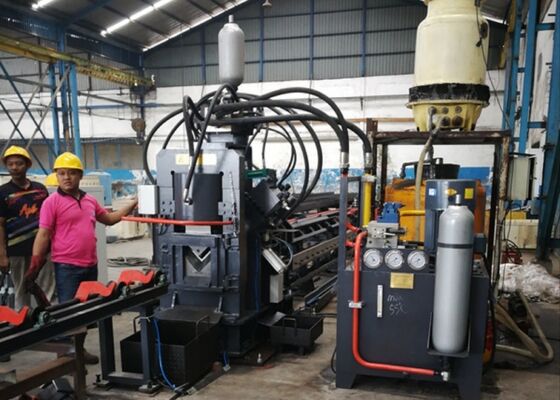
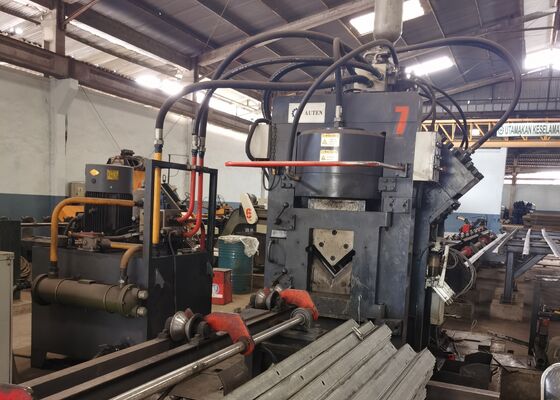
3 Punches Per Side Cnc Angle Steel Metal Punching Cutting Machine Line Model JNC1616
Product Introduction:
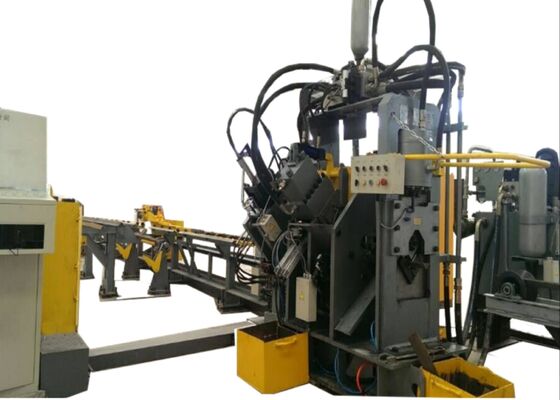
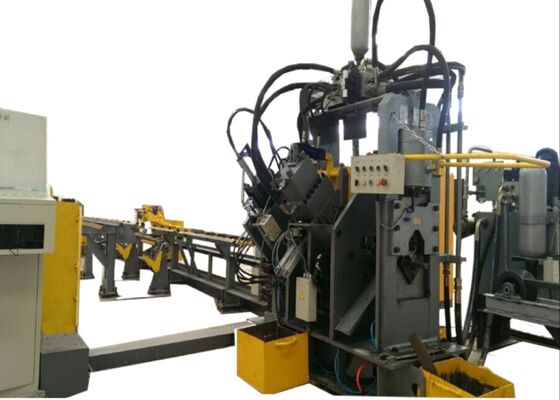
The machine is an automated production line designed for marking, punching (circular and oval holes), and shearing of angle steel. It is primarily used in industries such as angle steel tower manufacturing, electrical power fittings, structural storage solutions, and steel structure construction, among others.
Main Component:
This machine is primarily composed of a transverse conveyor, a rotating loading system, an infeed conveyor, a CNC infeed carriage, a punching unit, a marking unit, a cutting unit, an unloading conveyor, as well as hydraulic, electrical, and pneumatic systems, among other components.
Product Parameters:
| Model | JNC1616 |
| Angle size (mm) | 40х40х3~160х160х16 |
| Max. Punching (Dia. х Thi.) (mm) | Φ26х16 |
| Punching force (kN) | 1000 |
| Marking force (kN) | 1000 |
| Cutting force (kN) | 3000 |
| Max. length of blank (m) | 14 |
| Max. length of finished (m) | 12 |
| Punches per side | 3 |
| Group of marking letters | 4 |
| Number of letters per group | 18 |
| Character size(mm) | 14x10x19 |
| CNC axes | 3 |
| Cutting mode | Single Blade |
| Cooling method | Water cooling/Air cooling/Oil chiller |
| Max. feeding speed (m/min) | 80 |
| Programming mode | Lofting software or instruction programming |
| Overall dimension (m) | About 32x7x3 |
| The above parameters can be adjusted and changed according to customer's specific requirements. | |
![]()
Feature and consist parts:
1. Loading Section:
The loading system primarily consists of a horizontal transport table and a rotating loading unit.
(1) The horizontal transport table is driven by sprockets and chains, ensuring the synchronization of three chains equipped with shift blocks. This setup guarantees stable and low-noise operation during the transportation of the angle steel.
(2) The rotating loading unit is also driven by sprockets and chains, utilizing a long shaft and custom coupling to synchronize the three rotating arms equipped with reclaiming claws. The main function of this system is to transfer the angle steel from the trough on the material table to the feeding channel.
2. Feeding Section:
The feeding system mainly consists of the feeding channel and the CNC trolley unit.
(1) The feeding channel comprises conveying rollers, brackets, transmission racks, and moving raceways.
(2) The feeding trolley includes the moving body, clamper, clamping cylinder, swing cylinder, servo motor, and encoder. During operation, the feeding trolley moves along guide rails on the plane and side of the drive rack in the feeding channel, with the clamper following the commands provided by the computer.
![]()
3. Main Machine Components:
The primary system comprises the angle steel pressing unit, marking unit, punching unit, and shearing unit.
(1) The main function of the pressing unit is to apply pressure to the angle steel, preventing any deviation and thereby eliminating potential accuracy discrepancies.
(2) The marking unit is designed to facilitate positional changes within the four-character box. According to the computer’s instructions, it marks the angle steel at specified locations based on the drawing. A manual adjustment mechanism is also included, allowing for easy repositioning of the character head to ensure compatibility with different angle steel specifications.
(3) The punching unit is equipped with three different specifications of punches on each side, with each punch featuring an air cylinder. The piston rod of each air cylinder is fitted with a cushion block, positioned between the punching rod and the pressing head of the hydraulic cylinder. Based on the computer’s commands, the appropriate punch is automatically selected, triggering the corresponding air cylinder to push the designated cushion block, thus enabling the punch selection process.
(4) The shearing unit consists of a frame-type structure, a shearing cylinder, an upper blade mechanism, and a lower blade mechanism. The lower blade mechanism is adjustable to accommodate varying angle steel thicknesses, ensuring optimal cutting performance.
![]()
4. Discharging of Finished Products:
The system consists of a workpiece support roller and a rotating cylinder. Using the control button on the control panel, the processed workpiece is rotated and positioned on either the left or right side as required.
5. Hydraulic Station:
The hydraulic station includes an oil tank, high-pressure and low-pressure pump sets, a cooler, a main valve assembly, and other control valve assemblies. Its primary function is to provide power to the machine's hydraulic cylinders. The cooling system employs oil cooling technology to maintain optimal oil temperature and ensure efficient cooling performance.
![]()
6. Electrical Control System:
The electrical control system consists of an electrical control cabinet, an operation box, and a mobile operation station.
(1) The host computer is equipped with control software that facilitates the input of processing parameters for programming. It is also capable of recognizing programming files generated by CAD or CAM systems.
(2) The system employs a Mitsubishi PLC from Japan as the core control unit, integrated with a three-axis CNC module. This setup forms a position control loop in coordination with the X, A, and B axis servos, ensuring seamless integration between the PLC and CNC, thereby significantly enhancing the system's reliability.
(3) The drive system for the X, A, and B axes utilizes advanced AC brushless servo motors, ensuring rapid and precise positioning with zero maintenance requirements.
(4) The control software continuously monitors the machine’s performance. In the event of a malfunction, the system provides a detailed diagnosis, including the root cause and recommended corrective actions.
![]()
These samples, representing standard specifications and typical processing conditions in the angle steel tower industry, allow users to directly assess the equipment’s quality, precision, and workmanship. They act as a tangible reference point for evaluating the machine's performance and its compliance with established production standards, thereby supporting informed, data-driven decision-making for potential applications.
![]()
In the construction of ultra-high voltage (UHV) transmission lines, where towers endure harsh weather conditions and substantial loads, this equipment is crucial for processing the angle steel components that form the backbone of the towers. It efficiently performs drilling and stamping operations on the angle steel used for tower bodies, cross-arms, and other vital structural elements, ensuring precise dimensions and secure connections that uphold the overall stability and integrity of the towers.
コンタクトパーソン: Gaven
電話番号: +86-13306412803
ファックス: +86-531-5553-1208